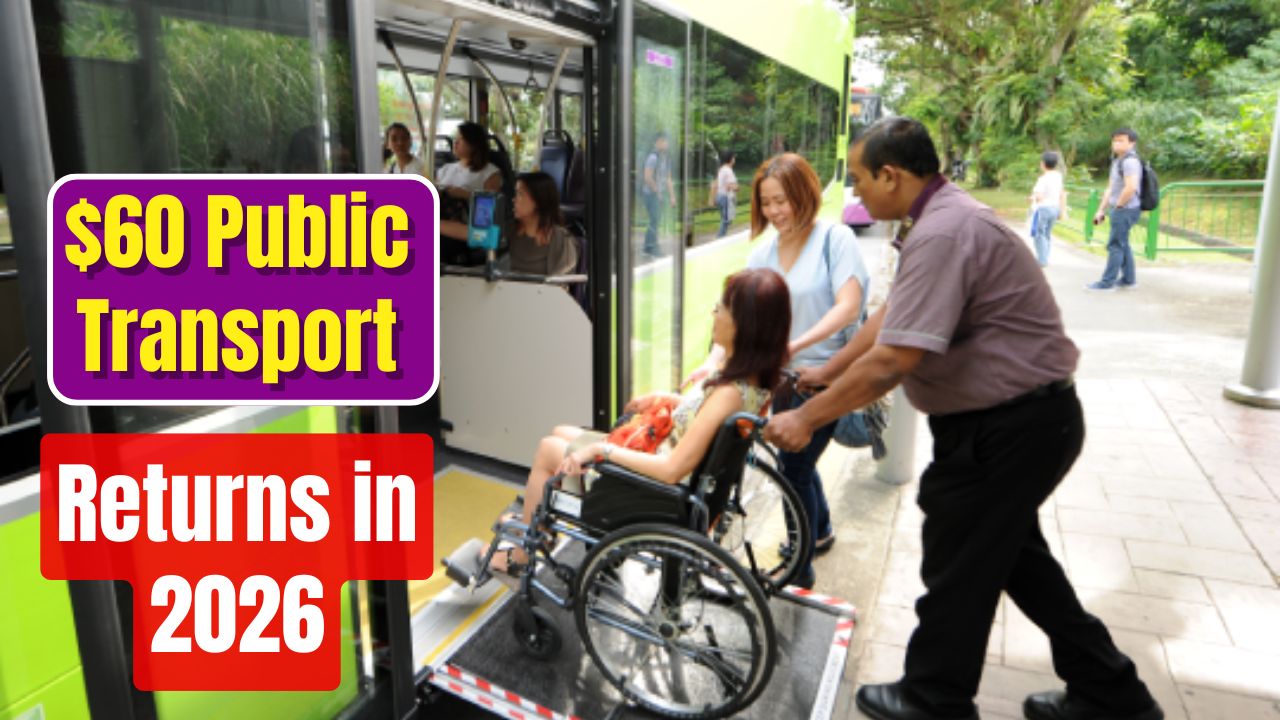
In 2026, the Singapore government will continue the Public Transport Voucher scheme, where each qualifying member is given transport vouchers worth S$60 to mitigate the impact of rising travel costs. The objective set is to render each resident a form of assistance while bus and train fare continues to go up, driving commuting costs down for the poorer and lower-income brackets.
How the $60 Public Transport Voucher Makes a Difference
From now until the very year of 2026, every household can give some relief to its residents by getting transport expenses reduced through the $60 public transport voucher. It can be directly used to top up the fare card, or for monthly passes. This serves to keep affordable access to mass rapid transport-for those in occupational or scholastic transit-plus relieve financial stress from these families.
Some Restrictions Intended for 2026 Lower- to Middle-Income Households..
In order to be considered for a transport voucher, households should fall under the cutoff according to certain income qualifications. A family who is eligible to access these vouchers must have a household monthly per-capita income equal to or less than the thresholds, as stipulated by the government.

At least one family member must be a Singapore Citizen or a permanent resident. It is the most vulnerable household earning the minimum income that deserves a right to the funds that have become scarce among them through the transport hikes.
How the Vouchers Are Distributed
Distribution of the vouchers takes place in stages. If there are households who have been receiving the assistance for the past exercise and are still eligible, they shall by default possess a notification to claim it.

Any new eligible households can submit their functioning through CCs or through the government portal during the opening of the application phase. Distribution is handled in such a way that all eligible households could come close to the support in the most efficient way.
When Should the Transport Vouchers Be Used?
The $70 voucher can be exchanged for the topping up of fare cards or payment for the purchase of monthly passes. To decide on the most suitable means of commuting, households can use the full period of validity of the vouchers (12 months). In order to make the best possible use of a voucher, individuals need to effect redemption immediately.

What Is the Objective of the Extended Scheme?
The voucher enables people from households whose earning power is low to control the rising cost of transport. They can now enjoy a cheaper commute throughout the year as they go to their place of work, school, etc., without worrying about their budget.
Residency Aspect
With the scheme, the immediate financial pressure on eligible households is reduced, thereby reducing the overall cost of getting around. This, in turn, reinforces social equity in that the scheme helps support people with the means to use public transport in coping with their cost of living.

How Do I Put in a Voucher and Apply?
To be in line with the government, citizens must have their household income updated in records. With the knowledge of their entitlement status, it effects a huge advantage on the application distribution procedures. For those who need help or advise on health schemes, coordinators of community centers are the people to approach.
Monitoring and Assistance
Once the vouchers are activated or applied, the applicants must also vigilantly monitor them to ensure money is being spent within the rules stipulated. In case of any hitch, the respective local government will sweep to your rescue, ironing out issues to ensure full benefit of the scheme to all residents.
In The Forward-Looking Vision
The continuation of the public transport voucher scheme at $60 in 2026 reflects that the country cares about people’s movability and the middle-of-risk containment with respect to everyday expenses.
It is, therefore, incumbent upon the government to extend its unconditional support to all entitled recipients to balance between the daily necessities of moving about and financial solvency.